
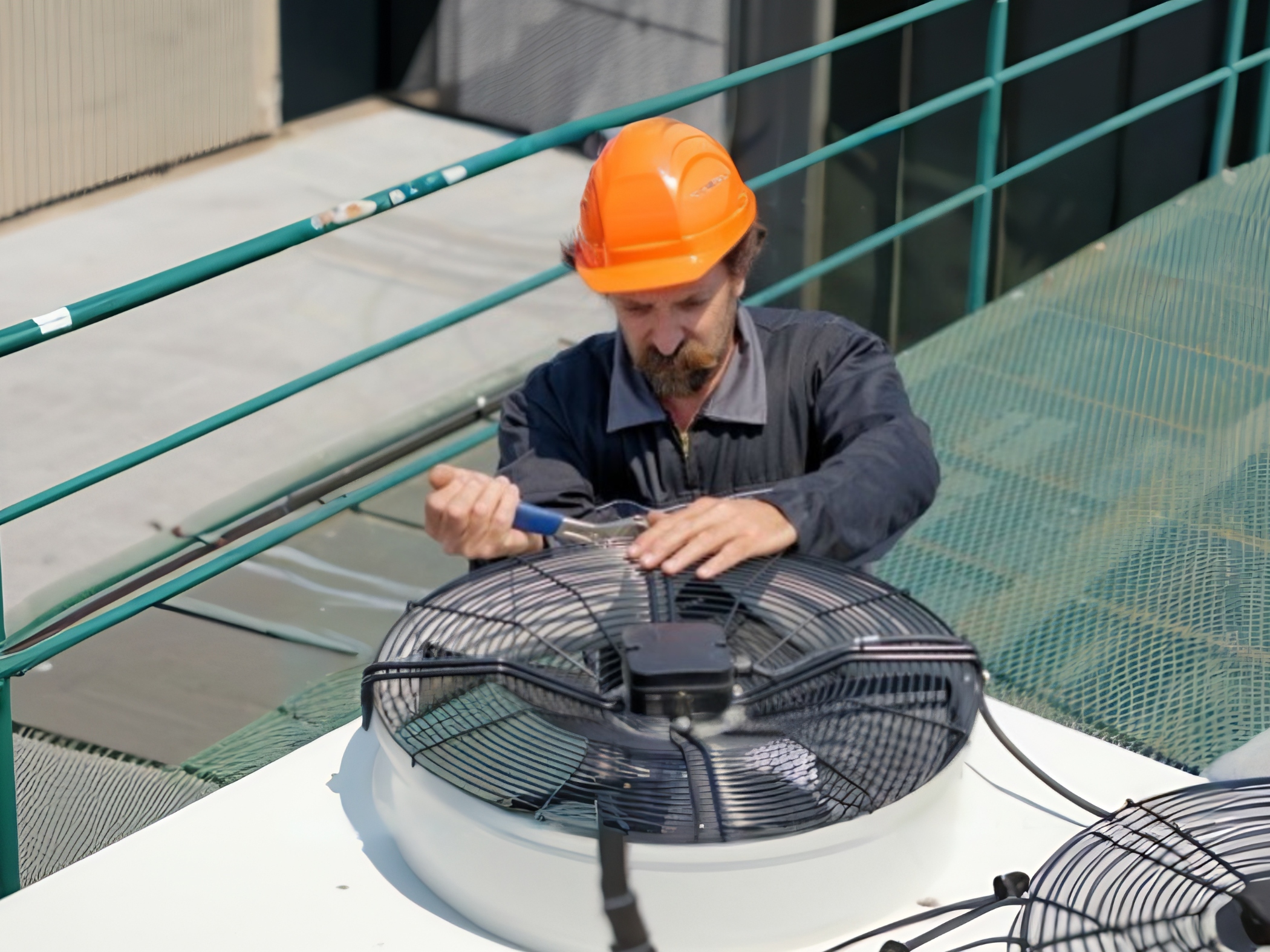
HVAC systems account for more than half of the energy used in commercial buildings. Upgrading to a new, high-efficiency system can significantly reduce your operating costs, and the following upgrade and operational strategies can also save energy while making your indoor environment more comfortable and productive.
1. Upgrade to variable speed drives
Variable speed drives (VSDs) are an economical and effective upgrade option that should be considered for all variable air volume systems. VSDs save energy by allowing air handling motors to operate at lower speeds to match demand rather than at a constant rate.
2. Rightsize fans
Oversized fans supply too much air, resulting in disturbing drafts, high humidity and noise. In these cases, smaller fans can save energy while improving comfort and increasing the life of motors and other system components. Consult with an HVAC engineer to make sure your fan system is sized correctly to optimize savings while maintaining an adequate supply of fresh air. Use the Fan System Assessment Tool in the U.S. Department of Energy's MEASUR software suite to evaluate your fan system's efficiency.
3. Install economizers
Economizers include a damper and a temperature sensor; they save energy by bringing in the right amount of outside air to provide cooling. When the outdoor temperature is right, the damper opens and lets in outside air for free cooling.
Dry-bulb and wet-bulb economizers are available. Dry-bulb units sense only temperature, while wet-bulb models gauge both temperature and humidity. Wet-bulb units provide enhanced comfort control, but they typically cost more to install and maintain.
4. Use synchronous belts
Most air handling systems use V-belts, which are up to 95% efficient when installed. That efficiency, however, will deteriorate over time if the belt is not re-tensioned frequently. Synchronous belt drives maintain a consistent 98% efficiency over a wide load range and require minimal maintenance.
5. Reset supply air temperatures
Cooling coils are typically designed to deliver air at 53°F to 55°F to meet air conditioning demands on the hottest day of the year. During mild weather, increase this temperature setting to eliminate wasteful reheating of already cooled air.
The most effective strategy is to reset supply air temperature proportionally based on the temperature outside. For example, set supply air at 53°F for outdoor temperatures of 80°F or above, and adjust upward to 60°F in cooler weather.
Looking for more money-saving strategies for HVAC and other building systems? See the heating, ventilation and air conditioning guide from Carbon Trust.